
ADVERTISEMENT
Chapter – 2 [Information Networks]- Notes
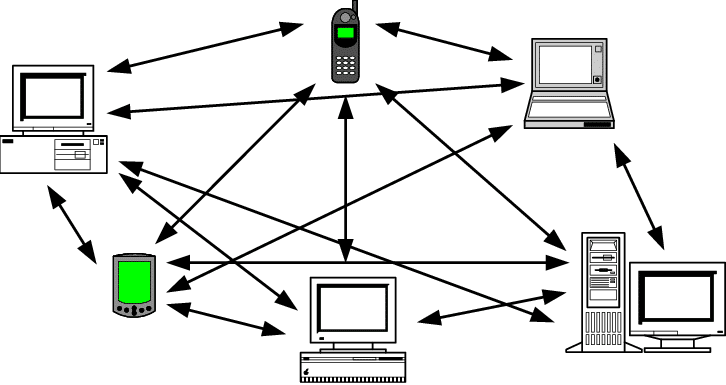
LAN. WAN, MAN, Computer Networks, Information Networks, Internet.
Q. What are information networks?
Information Networks:
- Information networks, or computer networks, are the convergence of two technologies: computing and telecommunication.
- This convergence resulted in LAN (local area network), MAN (metropolitan area network), WAN (wide area network), and the Internet.
- The networks were used for research among computer scientists and telecommunication engineers.
- Information networks have many useful benefits.
- It has also created some problems.
- The most popular information network is the internet, or World Wide Web.
- The users exchange information through the internet.
- The Internet is a large network through which information continuously flows.
- This circulation of information may flow rapidly or slowly.
The main advantages and disadvantages of a computer network are
Advantages | Disadvantages |
Sharing files becomes easy. | A hacker can get unauthorized access to files. |
Sharing of equipment becomes easy. | The cost of implementing a network is high |
Communication between two different makes of computers becomes possible. | If the core server fails, the entire network is affected. |
It improves communication speed and accuracy. | Managing a network requires experts in this field. |
Q. What is a network? Discuss different types of networks.
Network:
- When two or more two computers are connected through some communication medium, it is called a network.
OR
- A distributed data processing system is one in which multiple computers are linked together for the purpose of data communication and resource sharing.
Uses of networks:
- Networks allow users to share programs and data at the same time.
- Networks allow users to share peripheral devices.
- Networks allow users to send email messages along with attachments (files).
- Some networks also provide tools for teleconferencing and videoconferencing.
Types of Networks:
There are three types of networks.
- LAN (Local Area Network)
- MAN (Metropolitan Area Network)
- WAN (Wide Area Network)
LAN (Local Area Network):
- It is a digital communication system capable of interconnecting a large number of computers, terminals, and peripheral devices within a limited geographical area.
- It covers a small geographical area, such as an office or a group of buildings, e.g. College Lab, etc.
- Its speed is faster than WAN.
MAN (Metropolitan Area Network):
- A MAN connects an area larger than LAN but less than WAN.
- A MAN covers the geographical boundaries of a city.
- The purpose of MAN is to bypass local telephone companies when accessing long-distance services.
WAN (Wide Area Network):
- It is a digital communication system that interconnects different sites and terminals and also enables different LANs to communicate with each other.
- It covers a large geographical area, such as among cities, countries, or continents, e.g. the Internet. It is also known as a long-haul network.
- The larger computers in a WAN are hosts, and hosts are the computers on the network that provide services to other computers on the network.
- Terminal Emulation Software is used to allow the computer to appear as a terminal.
| Difference Between LAN and WAN: | |
| LAN | WAN |
| Area | |
| It is limited to small geographical areas. | It covers a large geographical area. |
| Connection | |
| Computers and devices are physically connected. | Computers may or may not be physically connected. |
| Devices | |
| Ethernet cards are used in LANs. | The modem is used in WAN |
| Speed | |
| Data transmission speed is very high. 100 Mbps to 1000 Mbps. | The data transmission speed is low. 56Kbps to 56Mbps |
| Cost | |
| Its cost of installation is less than WAN. | Its cost is high. |
| Error | |
| Its error rate is negligible. | The error rate is high. |
| Examples | |
| The computer lab of a college. | Internet |